Inside spazioSERRA’s New Season: Co- Presence is a Passing Gesture

Located at Lancetti Railway Station, spazioSERRA exists in a state of productive in-between. Neither fully a gallery nor simply a site of transit, the project inhabits a former octagonal newsstand with glass walls, a structure that resists enclosure. Art here is never entirely inside; it is already exposed to the city, to peripheral vision, to distraction, to the unplanned gaze of someone catching a train.
Founded in 2017 as a nonprofit curatorial initiative, spazioSERRA has consistently reimagined what public art can mean within the contemporary urban fabric. Its program unfolds not for a self-selecting audience, but for commuters, students, night workers, families; a public that does not necessarily choose art, yet finds itself momentarily in relation to it. The space operates through permeability: visual, social, temporal. What happens within its glass walls inevitably spills outward; what passes outside inevitably seeps in.

Co-Presence is a Passing Gesture inaugurates the new exhibition season not as a statement, but as an opening. Over the course of two weeks, spazioSERRA becomes the ground where different communities cross paths without fully dissolving into one another. The football field conceived with FIDATY SPA and activated by CALCIO LANCETTI introduces a structure, rules, teams, duration, only to let it be reshaped by whoever steps in.
Around it, other forms of gathering unfold. The reading room expands through the selections of Antigone and Potlatch, a workshop by SLIPMODE reactivates the tactile dimension of making and DARNA closes the day programs with a selection of screenings.

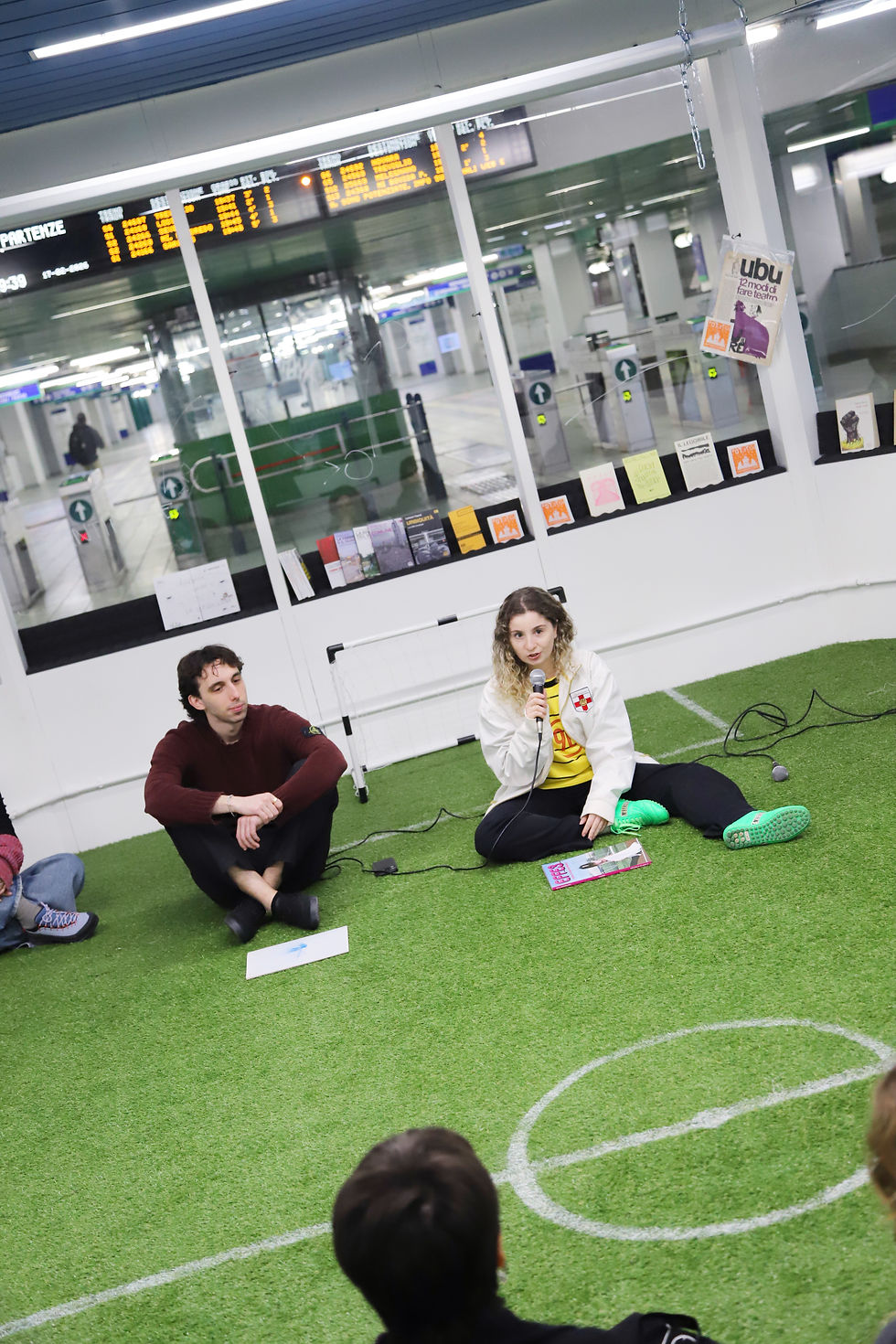
Rather than assembling a single community, the program allows for adjacency: groups that momentarily share a field, a table, a soundtrack. In a space defined by transit, collaboration becomes less about permanence and more about resonance.

Co-Presence is a Passing Gesture suggests that presence is fleeting yet transformative. How did this concept emerge, and how does it reflect spazioSERRA’s broader curatorial approach?
The idea emerged from a reflection on the fragile and temporary nature of encounters within shared spaces. We were interested in presence not as a stable condition, but as something that happens briefly, leaves traces, and then dissolves. In this sense, Co-Presence is a Passing Gesture reflects spazioSERRA’s curatorial approach, which often privileges process, relationality, and situated experimentation over fixed outcomes. The program embraces transience as a generative condition, allowing artistic gestures to act as catalysts for unexpected forms of attention, dialogue, and transformation. The idea is part of a broader reflection that will unfold throughout the season through different practices, formats, and encounters. The public program acts as an anticipation of this trajectory, opening a space to explore how presence takes shape in relation to artistic experience.

In a city like Milan, where public space is increasingly regulated and commercialized, how do you imagine public art can still create genuine encounters?
Real encounters rarely depend on scale or visibility. They emerge in small shifts, brief interruptions that slow the everyday rhythm and invite curiosity or pause. Even within regulated environments, public art can open micro-spaces of attention and informal gathering, where ambiguity can persist. Rather than confronting constraints directly, we work along their edges, using them to cultivate subtle forms of accessibility, intimacy, and shared experience.

How do you decide who to collaborate with? What affinities or tensions are you looking for?
Collaborations almost always begin in conversations that stretch out over time, in the recognition of a shared restlessness, and in the feeling of standing along the same social fault lines even when approached from different perspectives. Ther is often a common sensitivity to context, process, and relational practices, alongside the awareness that affinities alone are not enough. We are interested in working in ways that are both synergistic and mutually enriching.

Do these collaborations extend beyond the duration of the program, or are they intentionally ephemeral?
They can be both. Some collaborations naturally continue through future projects, friendships, or informal exchanges, while others remain intentionally temporary. We see ephemerality not as a limitation but as a meaningful condition that allows encounters to retain a certain intensity without the pressure of permanence. Even when collaborations do not formally continue, they often leave conceptual or relational traces that resurface later in different forms.


What does “co-presence” mean in an era increasingly defined by mediated or digital interaction?
Co-presence, for us, is closely tied to spectatorship and to the encounter between artwork and viewer. It concerns the moment in which attention, perception, and bodily presence activate the work, shaping a relation that is never fixed but continuously negotiated. The public program opens a space to reflect on these different modes of spectatorship and participation, while the first exhibition at the end of March will further expand this inquiry, allowing the relationship between artwork, viewer, and space to unfold in new ways.
Discover this weekend's program here

Pictures by spazioSERRA