Inside the Painted Room: The World and Work of Emilia Momen
I speak to Emilia Momen through a screen. There is a gentle evening warmth that is
lighting up her paintings which cover the walls behind her, studies of bodies and photos
she's taken, alongside finished work for an upcoming group show that she is preparing
for. She is soft spoken, and tells me about the last studio she has just moved from.
Where she used to live in a mezzanine behind a green velvet curtain, with her paintings
all around her as she slept.

She grew up with her mum and her granny always creating around her. Painting was the
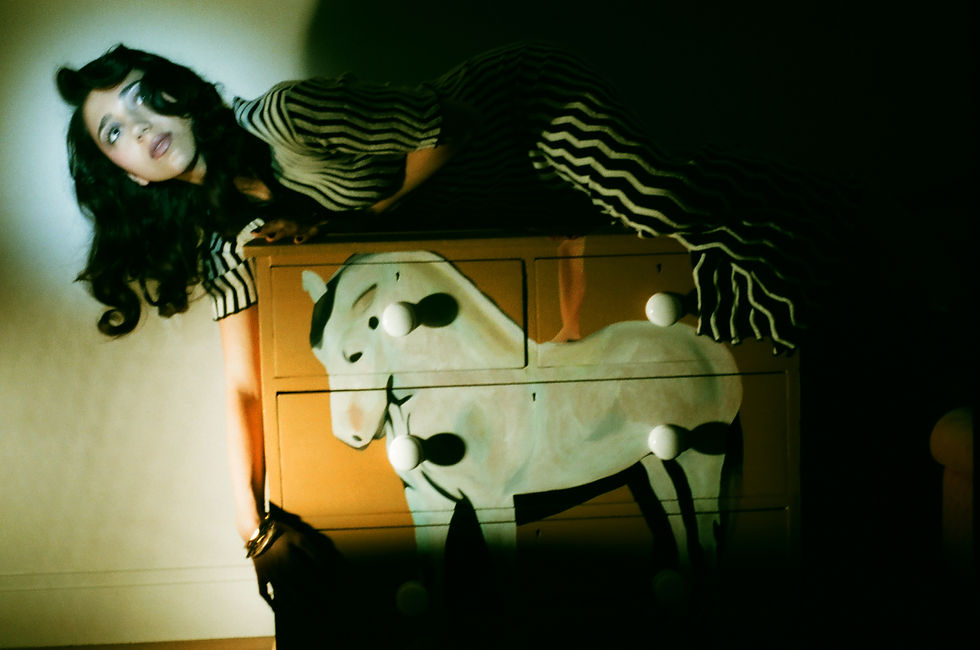
life of the house, she explains, as she shows me a chest of drawers where she has
painted a horse and a flamenco dancer onto the rustic wood, and describes her
childhood dream which was to cover all the walls with murals. Her family have always
collected antiques and so mending and designing were also a part of her world, all of
their wall space is covered with work from the women in the family. She looks around
her and muses at how there is barely any wall in sight. Her mother continued to paint
even when the walls were full, and Emilia showed me the spines of antique books that
have insects and animals painted onto them. Reclaiming these others' belongings as
their own. This creative family is perhaps why she originally wanted to be a designer, yet
the story of how she was drawn to a career in painting is one where a thread of gold
luck, one that Emilia seems to have, is woven through. Selected for the RA summer
exhibition at just 20, she was noticed by galleries, and had first solo show at Ronchini
Gallery in Mayfair at just 21. As she tells me about her life I glance at the studies behind
her which she explains were her experiments with colour.

You said that you work differently from the morning to the night, how do these two states
affect the work?
Well I spend all day in the studio, but morning and evening painting is completely
different for me. In the morning I’m painting within 15 minutes of waking, my mind is
fresh and it means I can really zone in. I will have the canvas in front of me and start to
visualise the entire painting, moving bits around for the best composition. However, I
find the evening is more exciting... I will listen to music, and I paint less pivotal parts
because of the lack of light...as I can’t risk waking up and seeing different colours in
natural daylight.

What was the first colour you remember gravitating to as a child? What colours have you
been introduced to recently?
Red has been my favourite colour since I was about 14, I love the intensity you feel when
looking at it. I was also introduced to ‘Indian Red’ by a fellow painter which I’m keen to
start using, but every time I have a fresh pallet, I seem to put the paints down in their
same spot so I’m not sure where it will fit!
What themes are you drawn to in your work at the moment?
I am currently creating a series of bathers paintings for my second solo show
with Ronchini Gallery. It was initially inspired by a Jim Lee photograph taken in 1970 of
four bathers lying on a grassy mound by water, which I recreated. Since then I have done many photo shoots of other bathers in similar locations, where grass meets water,
mostly in London parks.

You said you were very inspired by a photographer that you have been collaborating
with. Who was the photographer with whom you were working?
The photographer I have been collaborating with was Jim Lee who died last year, so I
have been working with his estate and archives. But the photos here were taken by Milly
Cope whom I followed on Instagram for a while, and this seemed like a great opportunity
to work with her. I love Milly's work, especially her portraits, they make great photos but
would also make great paintings, which is unusual, normally it's one or the other. Milly
also has a very gentle and relaxing way, so she gets the best out of you.


What are your other inspirations?
My favourite painting at the moment is Danny Fox’s Bathers. I get inspiration from other
painters and photographers or colours that, weirdly, work next to one another. I
constantly visit galleries and usually find one piece that I fall in love with and internalise
in some way. I’ve just been to Louisiana in Copenhagen and seen a great painting by
Mamma Anderson, but I love Peter Doig, Lisa Brice, Tim Walker, Toulouse-Lautrec, but if
I had to choose one person it would be Tracey Emin, she’s a huge inspiration,
particularly how she expresses her rawness and vulnerability.


How do your paintings at the beginning differ from now? Does your environment change
how you paint?
I tended to paint candid paintings of people I photographed as I walked past them on
the street, or friends on a night out, whereas now I choreograph my own photo shoots,
as I have a clearer idea of the end result and the composition I want to achieve.
Where has been your favourite place to paint?
Just before my first solo show with Ronchini in 2023, I had a studio on Lots Road just by
a jazz club, and my late nights spent there were magical, it's more about the state
you’re in and that flow of excitement rather than the actual room for me. Of course
sometimes when you look around and you are in a well lit Florentine studio it feels
surreal, but that fades within minutes... perhaps it’s why I have moved studios so many
times!

Do you have another favourite studio from another artist?
Yes, the Talgarth Road studios are great.... but I’d love any purpose built artist studio
with high ceilings. I recently visited an artist friend, and she had sliding doors from her
kitchen into her studio with huge ceilings and an enormous north facing window which
was incredible. But I love the setup of Louise Giovanelli's. It looks like she has a whole
art store in her studio.


If you were to have a dressing up box, what would be your favourite thing to dress up in?
My top hat is my favourite dressing up item, and appears in quite a few paintings. A top
hat used to be a symbol of male dominance, but I like to use it on women, I think it’s
elegant and gives more presence and prominence to the figure.
In the chest - where did the horse and the flamenco dancer come from? What is inside
the chest?
I had this old green chest of drawers, so I thought I'd paint on it until I had an idea for my
next painting. Mum has painted on lots of things in the house including book bindings
and cabinets, so it feels natural to do the same. I was in the middle of my circus series
at the time, and the horse and acrobat were part of that theme. I keep my dressing up
clothes inside, the ones I use for shoots.
Do you think there is no place like home? Where would you want to go next?
There's no place like home! Home to me is wherever my mum is in London, and room to
paint. Although.. I think a stint in the remote countryside would be fun.
When you were in Florence what was the thing that felt most like home there?
Being immersed in a painting gives me the feeling of contentment that home brings. I
loved the vintage Flea markets and the truffle gnocchi on Santo Spirito.
Authors Notes:
1 A dark earthy-red pigment with blue undertones. Used in Mughal art in the 17th/18th
century, and also in Jackson Pollacks ‘Mural on Red Indian Ground’ (1950)
2 21 Conduit Street, London W1S 2XP
3 I believe it was the 606 Club 4 Also known as a popular answer to the question: ‘What
are your favourite windows in London?’. Built in 1891 and designed by Frederick
Wheeler, the Windows next to the big busy road into Earls Court.
5 British Painter & Visual Artist, whose studio is in a former tram depot in Manchester 6
Famous top hat wearers include , Ladies of Llangollen
Talent: Emilia Momen @emiliamomen
Art director and Curator: Domino Leaha @domino_leaha
Photographer: Milly Cope @millycope
Producer: Elizabeth Bernet @elizabethbernet_
Hair Stylist: Reve Cheuk-Yin Lau @reveryuonly
Makeup Artist: Molly Whiteley @molly_whiteley
Wearing both full look Bottega Veneta