Refusing the Shadow: Chronic Illness, Digital Culture and the Subversion of Shame
When, in her controversial article for The Times, essayist Kathleen Stock cast a deeply suspicious eye on the growing presence of young women using canes, braces, and wheelchairs in public spaces and on digital channels, her reaction was no isolated case. By dismissing the use of mobility and medical aids as a form of "identity performance”, a passing fad, or a social-media trend to be shaken off in favor of learning to "stand on one's own legs," Stock gave voice to a mechanism of suspicion deeply rooted in contemporary culture.

What positions like this fail to grasp is that showing a medical need is never a neutral choice. Already in her celebrated essay Illness as Metaphor, Susan Sontag explained that when society doesn't know how to handle other people's suffering, it ends up turning illness into a personal fault. Instead of seeing physical pain for what it is, a medical fact, it judges it as a character flaw or a weakness of spirit. This is exactly what happens here: the medical reality of these conditions gets ignored and recast as laziness, lack of willpower, or a simple bid for attention on social media. On top of this blame, society adds a very precise expectation; what sociologist Talcott Parsons called the "sick role”. In essence, society grants you "permission" to be unwell only if you appear gray, passive, and visibly broken. If you don't play the part of the miserable sufferer, others immediately start doubting your pain. So when someone living with a condition refuses the stereotype of suffering and instead claims style, self-care, or beauty, their illness is instantly called into question. It is as if, to be taken seriously, we were forced to show only the worst side of pain, turning any desire for beauty or care into grounds for suspicion. The argument then collapses into a kind of contest over who has it worse, as though pain were only valid in the face of disabilities deemed "more severe”. It is a way of making people feel guilty and pushing them into silence. To claim, moreover, that people today invent vague diagnoses just to follow a trend ignores reality on two fronts: on one hand, medical research is finally recognizing chronic, invisible syndromes once dismissed as psychosomatic disorders; on the other, sharing experiences online among patients enables a vital word-of-mouth network, where exchanging information about specialists and aids helps people take back control of their own lives.
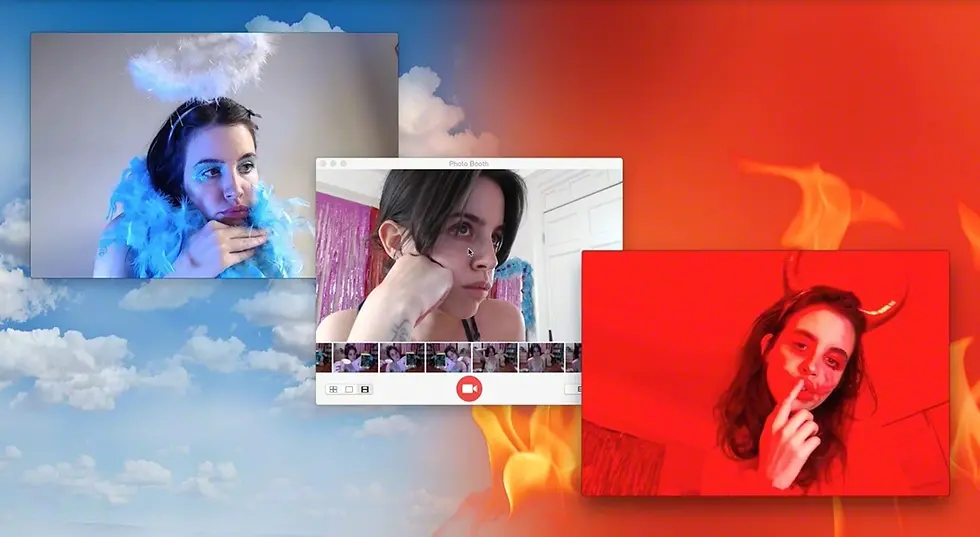
To truly understand this phenomenon, it must be situated within the history of digital culture and Net Art; a territory that has spent years reflecting on how private space can become a site of emergence and contestation. This new generation's attitude directly inherits the lesson of pioneers of digital culture like Molly Soda, aptly described as "Internet's daughter”.
In her solo exhibition From My Bedroom to Yours (2015), the artist reconstructed the intimate environment of her own bedroom to show that videos, selfies, everyday exhaustion, and self-care are not forms of exhibitionism, but a new aesthetics of intimacy.

We must not forget that the young women living with an illness or disability who populate these spaces are, first and foremost, digital natives: people born and raised inside the visual languages of the internet. What we are witnessing is not an illness masquerading as a trend, but a genuine aesthetic and digital current — made of collage, pop graphics, pastel pinks, stickers, and Y2K references. For those managing a chronic illness, using these languages is not a social media problem, but the most natural, generational way to tell one's own story: proof that the bedroom and the feed are not sites of isolation, but spaces in which to claim the right to exist on one's own terms.
This shared vulnerability thus becomes a space for building community and mutual support. Already in 1972, the manifesto Turn Illness into a Weapon by the Socialist Patients' Collective insisted that illness should not be experienced as a fault or a burden to be carried alone, but as an occasion for patients to build networks with one another. Today, online networks and exchange have become the natural place to find practical solutions for everyday life. In this sense, as Johanna Hedva explains in her Sick Woman Theory, even staying in bed is no longer a passive surrender, but can become a form of resistance. Hedva reminds us that politics is not made only by those who can take to the streets, but also by those who reject the culture of productivity at all costs, claiming instead the right to rest and to care. Showing oneself online and supporting one another from a distance thus becomes a concrete alliance: proof that one does not need a perfect, high-performing body to be heard. To be clear: this process does not aim to replace medicine, whose diagnostic role remains irreplaceable. What is being claimed is everything that happens outside the clinic; because beyond treatment there is a concrete existence to be managed every day. The network thus becomes the place where practical advice is exchanged and a genuine community of support is built. Of course, the risks of social media should not be ignored: hyper-exposure has its darker sides, and reducing one's whole person to a medical label is a real danger. The goal, however, is not to make illness one's identity, but to free it from shame so that the body can return to desiring and existing beyond the condition.

The new generations respond to this system using the languages of their own era: fashion, design, and the network. This is what Erving Goffman called the subversion of stigma: decorating a crutch, wearing a brace as an accessory, or showing a stoma with a crop top is not frivolity, but cultural sabotage. It means freeing the medical device from the weight of shame and reclaiming one's place in the world. This reflection sets out to show that taking care of one's appearance on social media does not mean pretending not to be unwell, but refusing the obligation to hide. If life today also happens through screens, then showing disability serves to break down the wall of isolation. A medical aid can be indispensable and, at the same time, beautiful, functional, and desirable. To those who dismiss this visual revolution as a passing trend, an open provocation remains: if tomorrow that same "trend" led a generation to wear an aid without shame and to demand accessible spaces for everyone, what would we truly have to reproach it for? If a cultural trend manages to dismantle stigma where politics has failed, then let the future belong to this new aesthetic.
