The Road Home: In Conversation with Federica Pantana
Every summer, Federica Pantana and I spend a weekend at my house in the Hudson Valley, upstate New York. This August, we sat down to discuss poetry, the law, and where we find home.

Monique Erickson: The theme of Mulieris' most recent issue is homeward.
Federica Pantana: New York is home. I chose it. I fought for it.
Momo: You just got your U.S. citizenship a year and a half ago. You are proudly Italian by birth. What does home mean to you?
Fede: The word homeward is interesting. I feel homeward bound when I come back to New York. I feel homeward bound when I return to Italy. Now that I survived NYC and became a New Yorker, I realize how precious my Italian background is: I need my family, my Italian home like never before. I return every summer to open my bedroom drawers and find old diaries, smell grandma’s coat that I inherited, use her tools to cook. I go back to keep the memories alive.
Momo: Homeward. Homebound. Bounds. There’s the sense that you're heading home but also, homebound: are you stuck there, stuck at home, bound at home?
Fede: True. I felt like that when I was younger. I grew up in Macerata, a little town lost in the Italian countryside, but I had that cosmopolitan urge: I just had to go. I started traveling when I was 12 for summer school.
Momo: You would leave your parents? Where did you go?
Fede: England, California, Texas; Yale, twice. Harvard. I never spent an Italian summer throughout high school and university. In high school, I’d say goodbye to my girlfriends at the train station and come back just when school was about to start. So that's what I'm doing: now that I’ve expanded my world and conquered these other achievements, I go back home to live what I didn't really live.
Momo: When we first met you told me ‘Pantchef is the alter ego I made up to survive the pandemic.’ The pandemic was the ultimate homebind.
Fede: I was alone in New York during COVID. It was very intense. I needed company. I’d record myself cooking and post it to Instagram. It turns out company was online. My personas are a mind-trick to keep me going: Francine, the poet by night, Fede, the lawyer by day, the Panthouse gardener, Pantchef the Italian cook, Lady Pant.

Momo: It’s quite the duality: lawyer / poet. How do the two forms / forums / formats coincide? Fede: For me, it was obvious that a poet who is good with the words becomes an attorney. Italian education focuses on the classics, looking backward. In high school, so much of who I studied were poets being lawyers, public speakers, statesmen, politicians. The eloquence and inspiration of poetry poured into the advocacy and oratoria of legal practice. Ovid of the Metamorphosis was a law student; in Rome, Cicero was an incredible orator, lawyer, and writer; Seneca was a philosopher, attorney and statesman. I grew up with this image of career binomial ingrained in my head. I was born a poet: I have been writing poetry since I was seven. It’s a no-brainer that the professional flip side would be studying law and becoming an attorney. However, in America, whenever I associate the two fields people are like, wait, what? How? It's two universes colliding.
Momo: You mentioned your persona, the poet Francine. Tell me the story of being named Francine.
Fede: The name Francine was given to me by Meryl, one of the oldest residents of the Chelsea Hotel. February 2016. I was 27. I’d just moved back to New York two days before from London. I had an interview in Midtown on the West Side, so I decided to stop by the Chelsea Hotel. I had this feeling it was going to give me good luck. I didn’t have a place to stay. I was couch surfing with friends. No visa, no job lined up. But I had a good, big law firm on my resume. Worst case scenario, I could always look for a job back in the UK. So, I gave myself three months to give it a try, to stay in New York. On the way to my first interview, I stopped at the Chelsea. I met Meryl, but I called her Mar. I thought, Mar hey Mar, oh, what's her name, Mar? And said, no, my name is Meryl. We sat down, and she says, ‘So Francine, you have some poems on you.’ I said, ‘actually, my name is not Francine, it's Federica.’ And she's said, ‘I'm going to keep you calling you Francine until you get my name right.’
Momo: That's your URL too: francinethepoet.com.

Momo: It’s inherently political to be a poet. To be a queer poet. To be a queer immigrant poet. To be a queer immigrant poet writing in her second language.
Fede: I'm a modern Sappho. And about politics, as a poet, I’m part of the poetry community. To make the world better right now, I start from my community: my family and friends, and the poet and artist community. If I ever divert my career from being a corporate attorney into more academia and I have more time, I’d love to support the Councilman Chris Marte, who helped save the Elizabeth Street Garden. He's a great guy. We did a rally at the garden and I spoke after him. Chris is on the street, helping, community by community, neighborhood by neighborhood. I think that's the way to make the world better.

Momo: Speaking of the poetry community, there’s grey area around how we met. I say we met in the Spring of 2023 at Easy Paradise. But you say we were in the same place at the same time November 2022 at Secret Pete’s, though we didn’t interact.
Fede: I remember that performance so clearly. My dad was there that night too. Even though he’s not proficient in English, he was impressed by your poem Avalon. We talked about the ending of the poem:
Momo: ‘Motherhood makes witches of us all.’
Fede: Exactly.
Momo: For your birthday two years ago, the poets conspired. We threw you a party at Clandestino and we all contributed to a joint poem in your honor. I had the last line: We love you and your pants.
Fede: That was the best birthday of my life. Because it was a surprise for me. I never would have expected to be given a collaborative poem that my friends wrote about me. And that is an epic line. Epic.
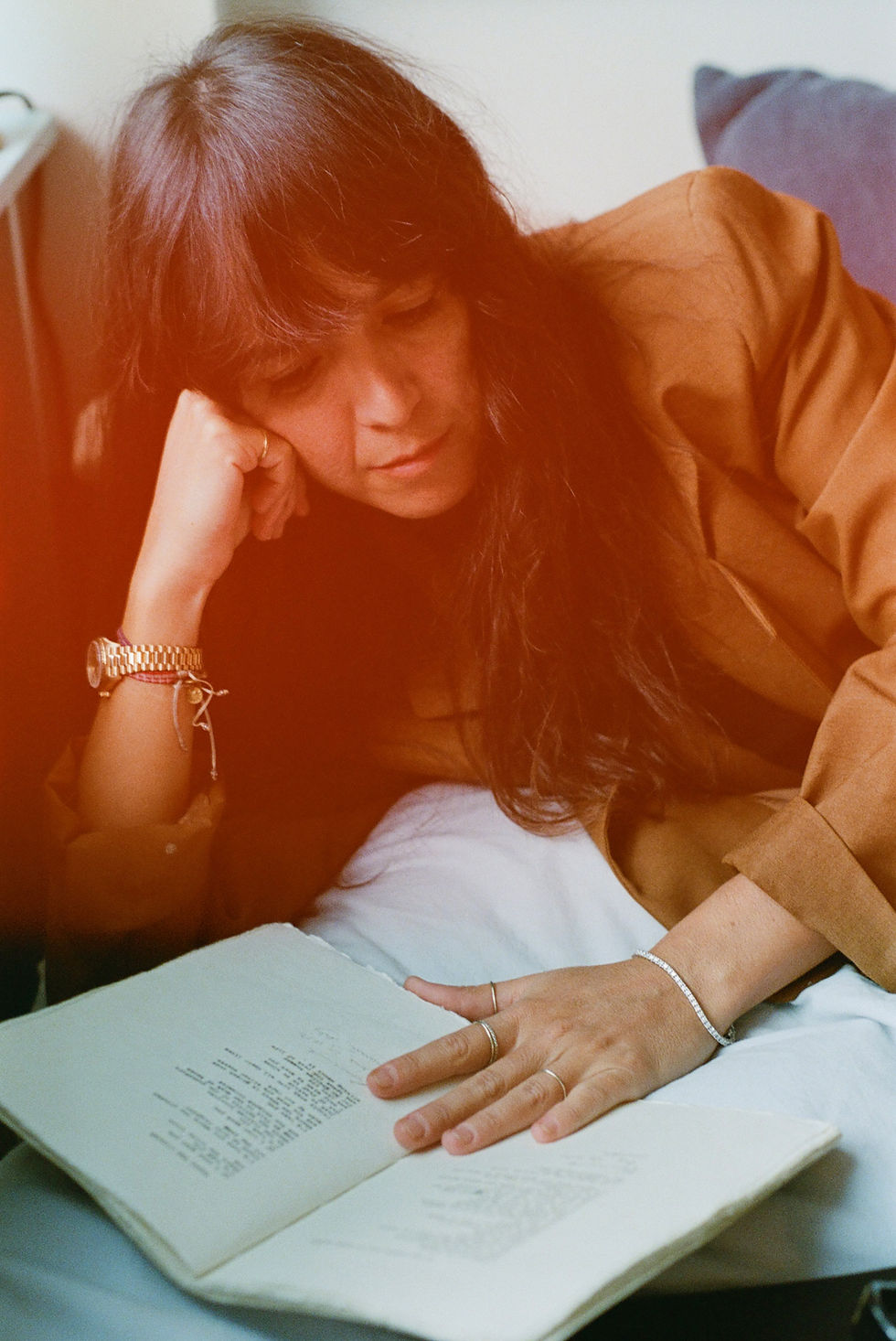
Momo: For me, one of the challenges of being a writer and a poet is having a family and having the space and the alone time needed to introspect and write.
Fede: It's not easy to balance normal life with poetry life.
Momo: As you say, poetry is a night shift job.
Momo: When I wrote your bio just now, I said you’re a lawyer, also a poet. That’s actually a Frank O'Hara reference.
Fede: Really?
Momo: When he died, the New York Times called him a museum curator, also a poet. The writer Ada Calhoun recently wrote a biography of her father's unfinished biography of Frank O'Hara called Also a Poet.
Fede: Ahhh, beautiful.
Talent: Federica Pantana
Curated by Domino Leaha
Photos and Art direction by Lily Burgess
Production by Elizabeth Bernet