École Monique Apple in Paris : A Feminist Approach to Language Learning
“What happens when language lessons spark empowerment?”That’s the question at the heart of École Monique Apple, a Paris-based initiative designed for migrant women who are taking their first steps in a new country. Offering a safe space to regain autonomy, the school also allows learners to connect with others, and prepare for professional integration.
Founded in 2021 by Elisabeth Bettencourt, EMA reflects a feminist, person-centered approach to education. Bettencourt named the school in honor of her mother, Monique Apple, an artist and writer whose values of care and justice shaped the project’s mission. Here, language learning is not treated as an isolated skill but as a holistic process tied to empowerment, socialization, and the development of new professional paths.
The school’s approach is inspired by the concept of scaffolding, introduced by American psychologist Jerome Bruner: a method where learners are supported step by step until they can move forward on their own.
Partnerships with institutions such as the Jeu de Paume museum and the city’s Beaux-Arts workshops extend this vision. Through visits, writings session, and public speaking exercises, participants engage with art and culture while strengthening their French. The result is a foundation for community, confidence, and lasting integration.
Mulieris sat down with the founder to learn more about the story behind this initiative.

What inspired you to create École Monique Apple, and how did it all begin?
École Monique Apple is the third language school where art is one of the pillars of learning, that I’ve founded since 2012 with multidisciplinary teams (language trainers, cultural mediators, actors) for different adult audiences. Despite very positive results of these programs, the group that faced the most challenges in progressing and integrating was qualified newly arrived women. And so I decided to create a hybrid and holistic project — both a language training organization with a professional focus and a feminist association — specifically adapted to this audience. The association was founded in 2021 and the first training sessions began in 2022.

Why was it important for you to create a program dedicated to women learners?
To address the multiple forms of discrimination faced by newly arrived women — academically and/or professionally qualified — in their path toward employment: to remove the language barrier that hinders their professional reintegration and to restore their confidence by valuing their skills.
We adopt a feminist pedagogy, based on an intersectional approach that highlights inequalities and discrimination (ethno-cultural, gender-based, racism, glottophobia). It draws on the learners’ own experiences and an inclusive, non hierarchical teaching posture, creating a space of empowerment conducive to inclusion and learning. This approach strengthens women’s confidence and autonomy, and values their knowledge, their journeys, and their multiple identities. By placing the learners at the center of the training process, É.M.A. is committed to providing an education that is fairer, liberating, and deeply human.
Can you tell us more about the women who join your programs?
They come from Ukraine, Afghanistan, Sudan, Bangladesh, Ethiopia, Pakistan, Palestine, Tibet… Some have fled violence; others joined a husband or a relative already settled in France. They all share the fact that they have recently arrived from non-European countries, speak little or no French, hold professional or academic qualifications from their countries of origin, and must adapt to a new life.
They are between 18 and over 60 years old, with most between 26 and 44. Their administrative status varies: refugees, family reunification, asylum seekers, holders of temporary residence permits. More than half have dependent children.
Their backgrounds are rich and diverse — medicine, education, administration, arts, journalism, architecture, crafts, services, engineering, law… Some wish to continue or resume studies, others to retrain, and others to practice their original profession in France. They all share a common need: to learn French quickly in order to realize their projects and integrate into professional and social life.


How would you describe your teaching method and the role art plays in it?
We offer intensive or semi-intensive courses over four months. The program is structured around three modules: French language, employment workshops, and culture through art and women’s rights.
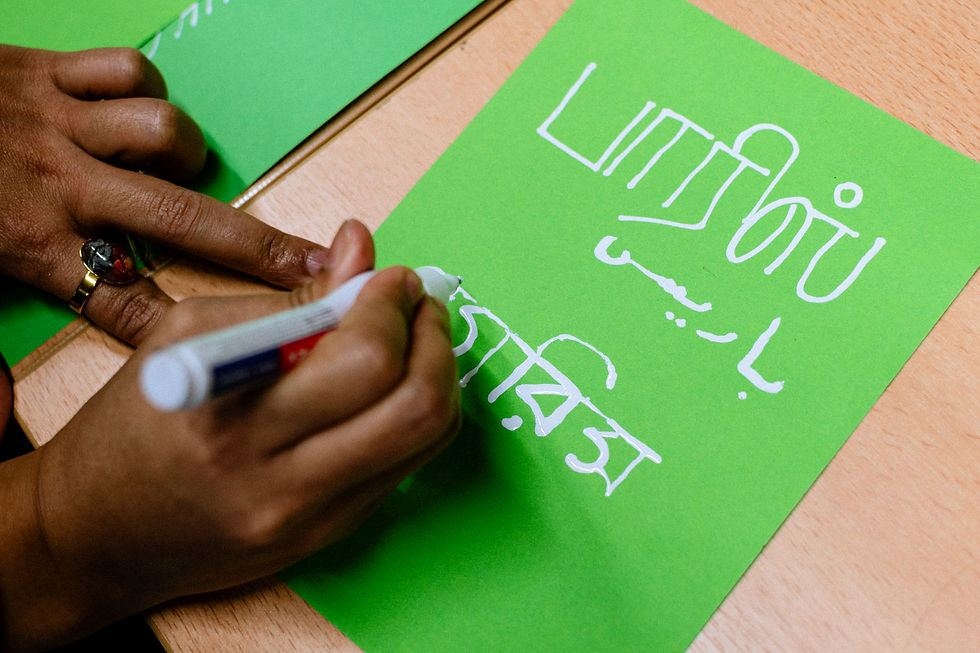
When it comes to art, what matters is not so much what we do, but how we do it. The “Integration through Art” projects are co-created with artists or cultural institutions and have been tested in practice. Art is a powerful means of communication: it allows learners to express themselves beyond language barriers, build confidence, and share their cultural knowledge, thus facilitating integration.
By creating a community around shared artistic experiences and actions, we offer a caring, inclusive environment that encourages exchange and learning. This approach values each woman’s cultural background and sensitivity, acknowledges her unique path, and connects it to a collective dynamic. It nurtures creativity, imagination, and emotional expression — all essential tools for empowerment and rebuilding identity, often shaken by the experience of migration.

What are some of the main challenges you’ve had to deal with recently?
The so-called “Darmanin Law” of January 26, 2024 — to be implemented in January 2026 under the slogan “controlling immigration, improving integration” — raises the language proficiency levels required to obtain residence permits. The evaluations we prepare our learners for have therefore become extremely high-stakes: they determine whether these women can stay in France. These tests risk turning into exclusion mechanisms. It’s a major responsibility for us to make sure every learner succeeds.
Like all French-language training organizations, we’ve also been affected by budget cuts and are expected to do more with less. The funding system for structures like ours is extremely fragile, as support is granted on a yearly basis.


What would you say has been your greatest achievement so far?
The September 2026 intake marked a turning point: for the first time, we have our own dedicated space — no longer just a temporary venue — a true training center and safe place in a working-class neighborhood of Paris. We now have three full-time employees and four independent collaborators, allowing us to train and support over 100 women this year, while continuing to assist former learners in case of interruption.
This year, we are supported by the Fondation d’entreprise Hermès, with whom we share deep human and qualitative values

How do you envision the future development of École Monique Apple?
Our goal is to build a sustainable future for the organization, developing a social and solidarity-based economic model founded on human value, balanced financial resources, and strategic partnerships.
We want to establish a strong presence in the working-class neighborhood of the 17th arrondissement, and build solid partnerships with other associations and local organizations, because I believe deeply in the strength of an ecosystem.
We also plan to design projects for other French-learning programs for migrant women (including those without formal qualifications in their home countries), and with cultural centers or artists, following the model we’ve created, to share our methods and spread our practices as widely as possible. We aim to share our expertise with employment networks and with social workers in Paris, raising awareness about the specific needs of the women we support.
We also plan to develop a professional French program focused on the fashion industry, starting in September 2026.
We can’t expand indefinitely by simply increasing the number of learners, as that would risk compromising quality. Currently, our training sessions take place across four different sites, but our facilities are too small to host all of them together. Our three-year goal is to expand into a larger shared space; to bring all our programs together, create a small childcare area for children, and establish a center for pedagogical experimentation and research, a unique place in France.
Photos by Irma Labelle